80% of the acoustic problems in a home studio live below 300 Hz. That's not marketing hyperbole: it's pure physics. The cause has a name —room modes— and a single practical solution: bass traps.
You can fill your studio with absorber panels, spend your salary on monitors, and still have uncontrolled bass that changes volume depending on where you sit. This article explains exactly what a bass trap is, why low frequencies are so hard to tame, how they work, how many you need and —most importantly— where to place them so they actually work.
What is a bass trap?
A bass trap is an acoustic absorber designed specifically for low frequencies, typically the 63 to 250 Hz range. Unlike a conventional acoustic panel —which absorbs mids and highs above 500 Hz very well but is almost transparent to bass— a bass trap is built to attack the part of the spectrum where a small room's real problems concentrate.
The difference isn't commercial, it's physical. To absorb a wave you have to intercept it where the air moves fastest, and bass waves only reach that speed far from the wall. That's why a bass trap needs three things a thin panel doesn't have:
- Thickness: 10 to 40 cm of absorptive material (or a thinner panel spaced off the wall with an air gap).
- The right density and material: porous, medium-to-high density, such as rockwool, fibreglass or technical foam.
- Strategic placement: at the points where bass pressure is highest — the corners.
Why low frequencies are the problem
The key is wavelength. Sound at 100 Hz is 3.4 metres long (343 m/s ÷ 100 Hz). In a room 3 or 4 metres across, that wave fits whole between two parallel walls, bounces back on itself and creates standing waves: axial modes.
At those modes, energy piles up into peaks of up to +15 or +20 dB at some frequencies and almost completely cancels at others. You know the practical result even if you didn't know why:
- A kick that sounds thunderous in your chair and deflates a metre away.
- A bass whose fundamental note seems to change volume depending on which key you play.
- Cancellations at the mix position that push you to boost bass that is actually excessive, so your mixes sound thin everywhere else.
An EQ won't fix this: an equaliser corrects the response at a single point, but the modal problem is different at every point in the room. And foam won't fix it either: you need real absorption below 250 Hz. That's where bass traps come in. To understand how much "tail" (reverberation) your room has and how to measure it, read what is RT60.
How they work: porous vs resonant
There are two families of bass traps, and it's worth knowing which one you need.
Porous absorbers
The most common type: blocks of porous material (rockwool, fibreglass, high-density foam) that turn sound energy into heat through viscous friction as air moves through the pores. They work broadband, but to reach the bass they need thickness. As a rule, a porous absorber starts working well from the frequency whose quarter-wavelength fits inside its depth:
- 10 cm of material → starts absorbing around 250-300 Hz.
- 30 cm (or 10 cm of material + 20 cm air gap) → reaches down to about 100 Hz.
The most cost-effective trick: space the panel off the wall with an air gap. It shifts absorption toward the bass without adding more material, because wave velocity is highest a quarter-wavelength from the rigid surface.
Resonant or membrane traps (Helmholtz)
A resonator is tuned to a specific frequency: a mass (a membrane or panel) over an air cavity that vibrates and dissipates energy in a narrow band around its resonant frequency. They're harder to build and only worth it when you have one specific, stubborn mode (say, a peak at 55 Hz a porous trap can't quite tame). For 95% of home studios, well-sized, well-placed porous traps solve the problem.
Commercial bass trap types
- Corner trap (triangular/prism): the most efficient format per square metre; it sits in the vertical corner. It's the format of our Havsvåg Corner.
- Superchunk: a solid triangular block that fills the entire corner floor to ceiling. Maximum bass absorption, but takes up a lot of space.
- Panel trap with air gap: a 10-15 cm panel mounted away from the wall. A good balance of effectiveness and looks.
- Tube trap: a cylinder that's half absorber, half diffuser — versatile but expensive.
The general rule: the more material you pack into the corner and the further it reaches from the rigid wall, the lower in frequency the trap will work.
Where to place them: the corner rule
Golden rule: corners first, always. In a corner, the bass waves arriving from different directions add up and pressure is at its maximum; putting the absorber there is the most efficient thing you can do with your budget. Priority order:
- Tri-corners: where three surfaces meet (two walls + ceiling, or two walls + floor). The pressure of axial, tangential and oblique modes all converge there. A rectangular room has 8: four up top, four at the bottom. Start with the four upper ones.
- Vertical wall-wall edges: the four vertical corners, floor to ceiling.
- Horizontal wall-ceiling junctions: especially the front wall (behind the monitors) and the rear wall.
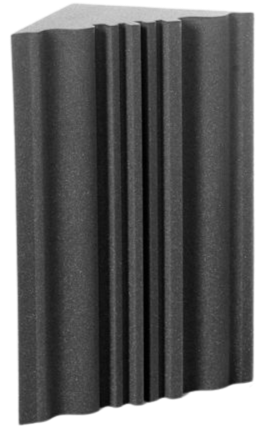
Bass traps are only half the treatment. For first reflections, the ceiling and the rear wall you'll need panels at the mirror points: we explain it step by step in where to place acoustic panels.
How many bass traps you need
It depends on room size and how severe your modal problem is, but as a reference:
- Small room (under 20 m²): at least 4 units (one per vertical corner); ideally 6-8 stacked for height.
- Medium room: 6-8 units, prioritising the upper tri-corners.
- Large room or badly uncontrolled bass: 8-12 units, adding horizontal junctions.
The professional studios' rule of thumb: for real bass control you should devote around 10% of the room's volume to low-frequency absorptive material. It sounds like a lot, but remember a porous trap is bulky out of physical necessity. If you want the exact number for your dimensions, our acoustic configurator calculates it for free, and how many acoustic panels do I need? walks through the full method.
NRC vs per-band coefficient: how to read a spec sheet
The most expensive buying mistake is looking only at NRC. The NRC (Noise Reduction Coefficient) is the average of absorption at 250, 500, 1000 and 2000 Hz. In other words, it completely ignores what happens below 250 Hz — exactly the range a bass trap is for. A product can boast "NRC 1.0" and absorb almost nothing at 80 Hz.
What to actually look at on a spec sheet:
- The absorption coefficient α per octave band, especially the value at 125 Hz (and at 63 Hz, if published).
- A good bass trap will have a high α —close to or above 1.0— at 125 Hz. Coefficients greater than 1.0 are normal in reverberation-chamber measurement due to the edge effect, not an error.
Our Havsvåg Corner publishes an α at 125 Hz of 0.99, precisely because that's the figure that decides whether a bass trap works or just decorates the corner.
Myths that will cost you money
- "Pyramid foam works as a bass trap." False. Decorative 3-5 cm foam absorbs nothing below 500 Hz; in the bass it's practically a mirror. It's for highs, not room modes.
- "A 5 cm panel in the corner is already a trap." No. Without thickness or an air gap, that panel works in the mids, not the bass.
- "The more, the better." With porous traps it's very hard to overdo the bass: it would take a huge amount of material. The real risk is the opposite — killing the ambience in the mids and highs if you scatter porous absorption all over the room, leaving it "dead" and dull. The solution is to concentrate bass absorption in the corners and treat the rest with judgement.
DIY vs bought
A bass trap is one of the few acoustic elements where DIY pays off if you're handy:
- DIY superchunk: 70 kg/m³ rockwool cut into triangles + a wooden frame + acoustic fabric. Approximate cost: around €35 per corner. It takes time, tools and handling wool with gloves and a mask.
- Bought: between €40 and €80 per unit depending on format and brand, ready to install, fire-certified and with no loose fibres.
When is buying worth it? When you value your time, need a fire-reaction certificate (mandatory if you record in a public venue) and want a clean finish. When DIY? If you have a workshop, a very tight budget and don't mind the finish.
How to know they're working
Don't trust your ears alone: measure. With the free REW (Room EQ Wizard) software and a UMIK-1 measurement microphone, run a sweep before and after installing the traps and compare:
- The waterfall (decay) between 60 and 200 Hz: you're looking for a decay-time reduction of over 30% in that band.
- The frequency response: modal peaks and nulls smooth out; the curve goes from roller-coaster to something flatter.
- The RT60 per band should flatten in the bass. If that metric is unfamiliar, we break it down in what is RT60.
If the decay at 80-120 Hz drops clearly and the kick "defines" across the whole room instead of only in your chair, they're working.
Frequently asked questions
Do I need bass traps if my room is small?
More than ever. The smaller the room, the higher and more problematic its modal frequencies and the closer together they are. Small rooms are exactly the ones that behave worst in the bass, so bass traps are essential, not a luxury.
Which corners do bass traps go in?
In priority order: first the tri-corners (where three surfaces meet), starting with the four upper ones; then the vertical wall-wall edges floor to ceiling; and finally the horizontal wall-ceiling junctions. The corner always before the flat wall.
How many bass traps do I need for 15 m²?
As a starting point, 6-8 units: cover the four vertical corners (stacking for height if you can) and add the upper tri-corners. Measure with REW and adjust; if you have a severe mode, go to the top of the range.
Does pyramid foam work as a bass trap?
No. It absorbs a little above 500 Hz, but below 300 Hz —where the modes are— it's almost transparent. For bass you need thickness and density, not pyramid relief.
Bass traps or EQ?
Bass traps. An EQ corrects the response at a single point and can't fill a modal cancellation: boosting 10 dB where the wave cancels only creates more energy and more problems. Bass traps attack the cause —the modal energy inside the room— and improve the response at every listening point. EQ is the final touch, always after treatment.
Start with the corners
Bass traps aren't the flashiest element in a studio, but they're the one that makes the biggest difference between a mix that travels well and one that only sounds good in your chair. If you don't know where to start, our acoustic configurator calculates how many you need and where to place them based on your room's exact dimensions, and you can see the Havsvåg Corner bass traps ready to install in the corners.