The only number that truly describes your room's acoustics
You can talk about "a drier room", "tighter bass" or "a more natural sound" for hours. None of that is measurable. But there is one parameter that is measurable, and that summarises the acoustic behaviour of any space in a single number: RT60, or reverberation time.
If you're going to invest time or money in treating your studio, understanding RT60 saves you from buying blind. You'll know exactly how much absorption you need, where the problem is and when to stop.
What RT60 really is
RT60 is the time, in seconds, it takes for sound pressure in a room to decay 60 decibels after the source has stopped. The definition is standardised in ISO 3382, the international standard that specifies how to measure room acoustics.
Why 60 dB? Because it's roughly the difference between the level of normal conversation and perceived silence. A sound that has decayed 60 dB is no longer audible to an average listener in a domestic room. It's the historical convention that has held since 1900.
An intuitive example: clap loudly in a church and the echo takes 4 seconds to die away → RT60 ≈ 4 s. Clap the same way inside a wardrobe full of clothes and the sound dies almost instantly → RT60 ≈ 0.15 s. Every room sits somewhere between those two extremes.
The Sabine formula: where it all started
Wallace Clement Sabine, a physicist at Harvard, discovered in 1900 that a room's reverberation time depends on only two things: its volume and the total absorption of its surfaces. The formula bearing his name is the foundation of all modern architectural acoustics:
RT60 = 0.161 · V / A
Where:
- V = room volume in m³
- A = total absorption in sabins (sum of each surface × its absorption coefficient α)
- 0.161 = constant derived from the speed of sound (in metric units)
Real numerical example
Picture a typical home studio: 4 × 3 × 2.5 m = 30 m³ of volume. Drywall walls, wooden floor, plain ceiling. Average absorption at 1 kHz is roughly α = 0.08 (very reflective room). Total surface area ≈ 59 m².
A = 59 · 0.08 = 4.72 sabins
RT60 = 0.161 · 30 / 4.72 ≈ 1.02 seconds
A whole second of decay in a 30 m³ room is enormous. A mix done there will sound blurred, the bass piles up and the stereo image is diffuse. To bring it down to 0.3 s you'd need to push A up to about 16 sabins — meaning more than tripling the room's absorption.
When Sabine breaks down
The Sabine formula assumes uniform and moderate absorption (mean α < 0.3). When you start treating aggressively and the average coefficient exceeds that threshold, Sabine overestimates RT60. In those cases the Eyring formula, which is more accurate for treated rooms, is used instead. But for designing the treatment of a home studio, Sabine is accurate enough.
T20, T30, EDT: why nobody actually measures 60 dB
Measuring a real 60 dB decay requires an extremely low background noise (≈ 10 dB SPL) which is impossible inside a home. The fridge, traffic or even your own breathing are already louder. That's why in practice we use variants:
- T20: the decay between -5 dB and -25 dB (20 dB) is measured and extrapolated linearly to 60 dB
- T30: same idea but between -5 dB and -35 dB — more accurate but requires more dynamic range
- EDT (Early Decay Time): the first 10 dB of decay extrapolated to 60. It's the metric that best correlates with the subjective perception of reverberation, because your brain judges the tail by its earliest moments
In a homogeneous room, T20 ≈ T30 ≈ RT60. When they differ noticeably it means the decay is not linear — a typical symptom of unresolved modes or concentrated late reflections.
The modern computation method is Schroeder's reverse integration over the room's impulse response (measured with a logarithmic sine sweep). You don't need to understand the maths: the software does it automatically.
The ideal value for your home studio
Official recommendation (EBU Tech 3276)
The European Broadcasting Union published in its technical standard 3276 a formula for the target RT60 in stereo control rooms:
Tm = 0.25 · (V / V0)^(1/3) seconds, with V0 = 100 m³
For a typical 30 m³ room this gives Tm ≈ 0.17 s, with a tolerance of ±0.05 s between 200 Hz and 4 kHz. It's a very demanding target, designed for professional rooms.
Practical reference values
For a realistic home studio, the acceptable range is slightly more generous:
- Well-treated home studio: 0.3 – 0.4 s (200 Hz – 4 kHz)
- Professional mixing room: 0.2 – 0.3 s
- Untreated domestic room: 0.6 – 1.2 s
- Empty room with hard walls: 1.5 – 2.5 s
- Typical classroom or meeting room: 0.8 – 1.5 s
- Classical concert hall (comparative reference): 1.8 – 2.2 s
If your RT60 is above 0.5 s in the mid band, you'll have obvious clarity and stereo imaging problems.
Spectral linearity: the data the average hides
A mean RT60 of 0.4 s sounds perfect. But if you break it down by octave bands and discover that at 80 Hz you have 1.2 s and at 4 kHz you have 0.2 s, that room is completely unbalanced. The bass drags, the highs are dead, and the result is a mix that will sound bad anywhere else.
The goal isn't only lowering the average RT60: it's making it flat across octave bands. The EBU allows a maximum deviation of ±0.05 s between 200 Hz and 4 kHz, and a bit more below 200 Hz (where controlling bass is harder).
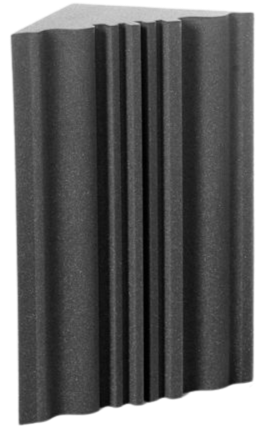
This is why bass traps matter so much. Most thin panels absorb very well above 500 Hz but barely touch the bass. A room full of thin panels ends up with dry highs and uncontrolled bass — exactly the spectral imbalance that ruins mixes.
How to measure RT60 at home
The de facto standard in home studios is free and reliable:
1. Software: REW (Room EQ Wizard)
Free, cross-platform, exports professional graphs. It's the tool used by mastering engineers, home cinema integrators and acoustic designers. Download it at roomeqwizard.com.
2. Hardware: a calibrated measurement microphone
A miniDSP UMIK-1 (~€75) is the absolute standard. USB-connected, ships with an individual calibration file downloadable by serial number. Cheaper alternatives (~€30-40) work for a first approximation, but the UMIK-1 is the investment that makes everything else credible.
3. Procedure
- Connect the UMIK-1 to your computer, load the calibration file in REW
- Place the microphone at the listening position, at ear height
- Play a sine sweep from 20 Hz to 20 kHz through your monitors
- REW computes the impulse response, Schroeder integration, RT60 per band
- Look at the RT60 vs frequency chart: the goal is a line as flat as possible around your target value
The first measurement of your untreated room is an educational experience: you instantly see where the problems are (almost always, runaway bass and overly lively highs).
How to lower RT60: how many sabins you need
From the Sabine formula you can directly derive how much absorption you need to reach your target. Back to the 30 m³ room example:
- Current state: A = 4.72 sabins → RT60 = 1.02 s
- Target: RT60 = 0.35 s
- Solving: A = 0.161 · 30 / 0.35 ≈ 13.8 sabins
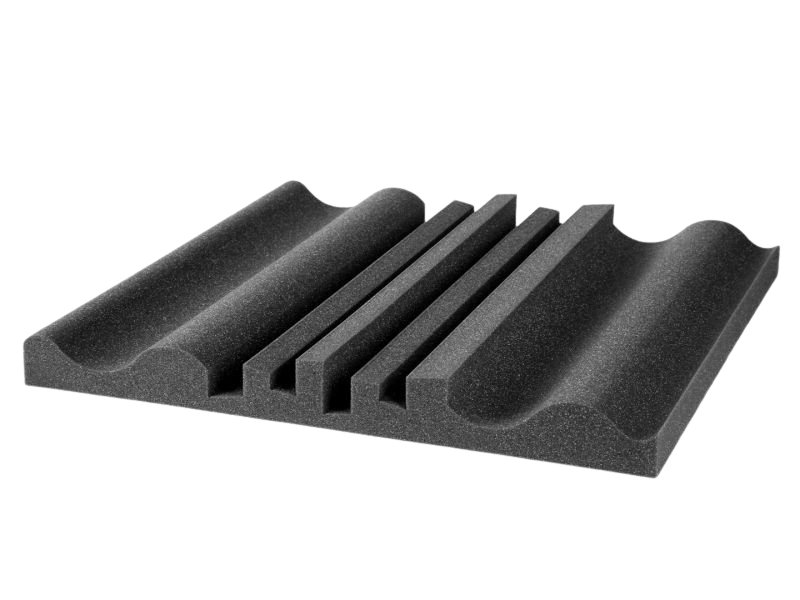
You need to add ≈ 9 sabins of absorption. A good 60×120 cm acoustic panel with 10 cm thickness contributes roughly 0.6-0.9 sabins per panel at 1 kHz (varies by frequency and mounting). That means: 10-15 well-placed panels to reach the target.
The key phrase is well placed: the same panels distributed at random perform much worse. Correct placement (corners for bass, mirror points for mids and highs) is what turns those 13.8 sabins on paper into 13.8 real sabins.
RT60 is the rule, not an opinion
Once you have your RT60 measurement and a clear target, acoustic treatment stops being a matter of taste and becomes a matter of numbers. You know how many sabins you're missing, in which bands, and that determines exactly how many panels, of what thickness and where to place them.
Our acoustic configurator does all that calculation for you: enter your room dimensions, surface materials and RT60 target, and it returns the exact list of panels and bass traps you need, with placement. In 2 minutes. Free.
The difference between treating acoustics with data and treating it by ear is the difference between a mix that travels well and one that only sounds good in your room.