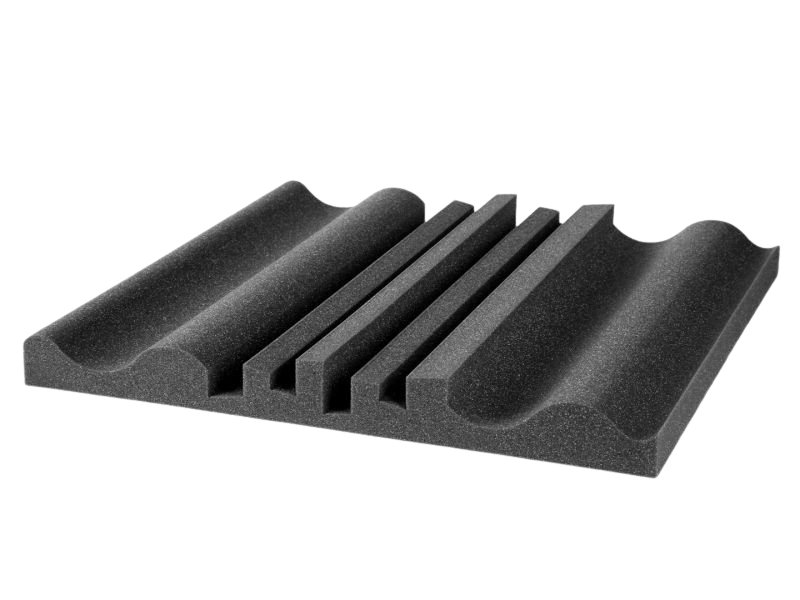
Havsvåg FR-950 acoustic panels
High-density acoustic foam for first reflections
The Havsvåg FR-950 is our broadband absorber. Designed to treat first reflections on side walls, ceiling and the listening area of your home studio. 28 kg/m³ open-cell polyurethane foam, E-d0 fire certified, made in Spain.
- High-density (28 kg/m³) ZH FR28 acoustic foam
- NRC 0.75 — absorption measured per ASTM C423
- E-d0 fire certified (self-extinguishing)
- Available in anthracite and burgundy
- Packs of 8 or 12 units · 48-72h shipping
What acoustic panels are for
Acoustic panels absorb mid and high-frequency reflections bouncing off your room's walls. Without treatment, those reflections reach the listener a few milliseconds after the direct sound, generating comb-filter colouration that muddies the mix and hides stereo detail.
The Havsvåg FR-950 is designed for first reflection points: the ceiling cloud between your head and the monitors, the side walls at ear height and the rear wall when the room is small. With 8 to 12 panels you can already reduce the average RT60 of a domestic room by 40-60% in the 500 Hz – 4 kHz band.
How many panels do I need
The amount depends on room volume, building materials and use (mixing, recording, podcasting). Quick reference:
- 6-10 m² room: 6-8 panels + 2-4 Havsvåg Corner bass traps
- 10-15 m² room: 8-12 panels + 4 bass traps
- 15-25 m² room: 12-16 panels + 4-6 bass traps + 2-4 QRD diffusers
For an exact calculation based on your real room dimensions, use our free acoustic configurator — it returns the precise quantity and position of every panel.
Comparison with pyramid foam
The decorative pyramid foam sold on Amazon or AliExpress has a density of 10-15 kg/m³ and an effective thickness of 30-40 mm. Below 500 Hz its absorption coefficient is essentially zero. The Havsvåg FR-950, at 64 mm thick and 28 kg/m³, starts working from 250 Hz (α 0.37) and keeps α > 0.7 between 500 Hz and 4 kHz.
In practice that means 8 FR-950 panels deliver the same control as 25-30 cheap foam panels, while taking up less wall and using fire-certified materials.
FAQ
How is this different from Amazon foam?
Density and certification. Our ZH FR28 foam is 28 kg/m³ (vs. 10-15 kg/m³ for decorative foam) and E-d0 fire certified. That translates into real absorption below 500 Hz and code compliance if you record in a public venue.
How many panels do I need for my room?
For a 10-15 m² home studio the usual setup is 8-12 FR-950 panels plus 4 Havsvåg Corner bass traps. For an exact calculation, use the configurator.
How do they attach to the wall?
With double-sided acoustic adhesive or DIY frames when the wall doesn't allow glue. There's a step-by-step guide on the blog.
What are acoustic panels for?
To absorb mid and high-frequency reflections that bounce off the walls and muddy the mix. They reduce reverberation time (RT60) in the 500 Hz – 4 kHz band and eliminate comb-filter colouration at the listening position. They don't soundproof: they treat sound inside the room, not what gets in or out.
What glue should I use for acoustic panels?
Use double-sided acoustic mounting tape or a spray adhesive like 3M Hi-Strength 90. Apply at 4 points per panel and press for 30 seconds. Avoid neutral silicone: it takes 24h to cure and can't be removed without damaging the wall. If you don't want to glue, mount the panels on screwed-in wood battens.
What material are acoustic panels made of?
The FR-950 is made of open-cell polyurethane foam, type ZH FR28, with 28 kg/m³ density and E-d0 fire certification. Open-cell structure lets the sound wave penetrate and dissipate as heat through internal friction. Alternatives include rockwool (heavier), fibreglass (irritant) and recycled felt (worse bass absorption).
At what height should I mount acoustic panels?
Side panels go centred at seated ear height (1.1–1.3 m from the floor) at the first reflection point. The ceiling is treated with a cloud of 2-4 panels between the listener's head and the monitors. The rear wall gets coverage from 1 m to 2 m height.
How to position acoustic panels correctly?
Use the mirror trick: have someone slide a mirror along the wall while you sit at the mix position. Wherever you see the monitors reflected, place a panel. Repeat for the opposite wall, the ceiling and the monitors. Those are the first reflection points. For bass, corners are always the priority.