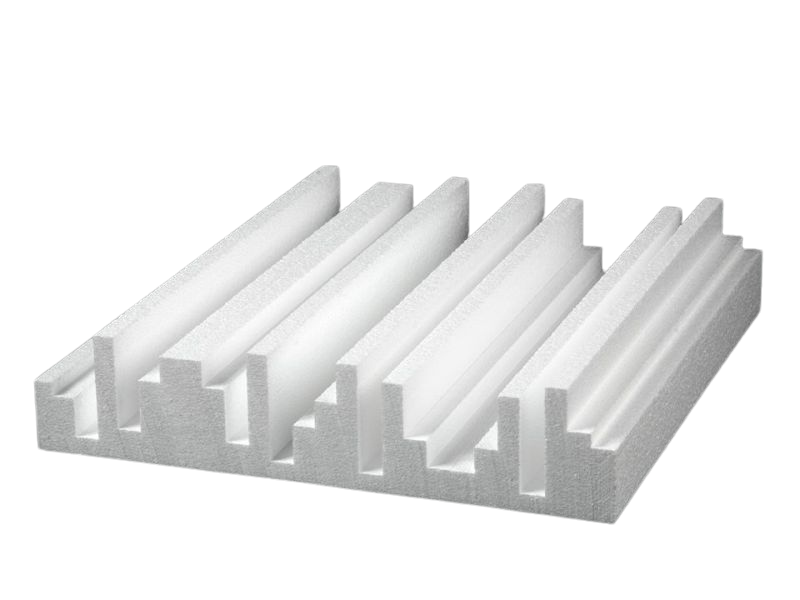
QRD Studio acoustic diffuser
QRD diffuser that keeps the room alive without specular reflections
The QRD Studio is a Quadratic Residue Diffuser made of high-density EPS. It goes on the rear or side wall to scatter reflections without absorbing them: the room keeps its natural energy and reverberation but loses direct echo and comb-filter colouration.
- QRD (quadratic residue) design optimised for home studio
- Diffusion range: 630 Hz – 8 kHz
- Dispersion range: 500 Hz – 8 kHz
- High-density EPS at 30 kg/m³ — lightweight and durable
- Paintable white with water-based paint without acoustic loss
Diffuser vs absorber panel
An absorber panel turns acoustic energy into heat — it lowers RT60 but can dry out the room if you overdo it. A diffuser spreads the energy across many directions, removing specular reflections (direct echoes) without reducing total sound. That preserves the "live room" feel you need to record vocals or acoustic instruments.
In a typical home studio, the correct mix is: FR-950 panels at first reflections (sides + ceiling), Havsvåg Corner bass traps in the corners, and QRD diffusers on the rear wall. This recipe avoids the two classic pathologies: echoey room and over-deadened room.
Where to install them
- Rear wall of the mix position (opposite the monitors): main destination. Minimum listener distance: 1.3 m.
- Rear ceiling: when the room is tall and the rear ceiling bounce causes echo.
- Side walls behind the listening position: to preserve the sense of width.
They don't belong at first reflections — that zone asks for absorption, not diffusion.
How to size the quantity
As a rule, cover 10-20% of the rear wall with diffusers and absorb the rest. For a 4×2.5 m wall (10 m²) 2-4 QRD Studio units are usually enough. For the exact calculation with your dimensions, the acoustic configurator includes it in the result.
FAQ
What is a QRD diffuser?
A quadratic residue diffuser: a surface with wells of depths set by a mathematical sequence (prime modulus) that scatters sound in a predictable hemispherical pattern. Invented by Manfred Schroeder in the 70s.
Can I paint it?
Yes. Acrylic or vinyl water-based paint. Apply a thin coat with a roller so the wells don't get clogged. Solvent-based paints can attack the EPS.
Do I need it if I already have panels and bass traps?
If your room sounds 'dead' or lifeless after adding absorption, yes. A diffuser brings back naturalness without reintroducing comb-filtering. If the room already sounds good, it's optional.