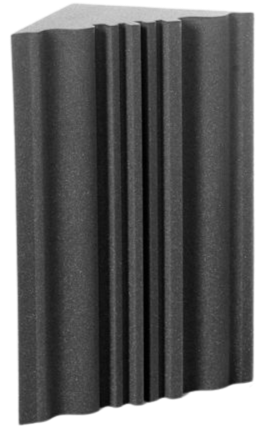
Havsvåg Corner bass traps
Corner bass trap to tame room modes
The Havsvåg Corner bass trap is a large triangular absorber designed to sit in the vertical and horizontal corners of your room. That's where bass builds up (maximum pressure of axial and tangential modes) and where a bass trap delivers its peak performance.
- NRC 1.15 — peak absorption measured in reverberant chamber
- ZH FR28 foam at 28 kg/m³ with E-d0 certification
- Corner format 300×300×600 mm — covers 60 cm of corner
- Available in anthracite and burgundy
- Packs of 2, 4 or 8 units · 48-72h shipping
Why you need bass traps
Any rectangular room develops standing waves between parallel walls: room modes. These modes concentrate energy at specific frequencies (typically 30–200 Hz) and generate peaks and nulls of up to ±15 dB. A corner bass trap absorbs that energy exactly at the highest pressure point, which is always in the corners.
Without bass traps you might hear sub-bass clearly in your chair that vanishes a metre away, or a kick whose level changes depending on where you sit. That's not a monitor problem — it's a modal problem that only low-frequency absorption can solve.
How many bass traps you need
Rule of thumb: cover the 4 vertical corners of the room from the floor up to at least 1.2 metres (2 stacked units per corner = 8 units). If the room is long (>5 m) or has severe modal issues below 50 Hz, add 2 horizontal units along the ceiling/rear-wall joint.
- Small room (6-10 m²): 4 bass traps (1 per corner)
- Medium room (10-15 m²): 8 bass traps (2 stacked per corner)
- Large room (15-25 m²): 8 + 2-4 horizontal on the ceiling
Combine bass traps with Havsvåg FR-950 panels at first reflection points for full-range treatment.
Installation
The Havsvåg Corner sits directly on the floor in the vertical corner, stacking units until you reach the desired height. For permanent fixing, use double-sided acoustic adhesive on the two flat faces of the triangle. No extra framing, no drilling required.
FAQ
What exactly is a bass trap?
An acoustic absorber optimised for low frequencies (typically <300 Hz). It sits in the corners because that's where modal pressure peaks and particle velocity is minimum, maximising absorption for a thick porous absorber.
Is it better than rockwool wrapped in fabric?
Performance is similar at 125-250 Hz but it wins on safety (E-d0), installation (no framing) and weight. If you want pure DIY and the absolute best sub-bass control, 100 mm rockwool is still a valid option.
How many units per corner?
The useful minimum is 1 per vertical corner (4 units). The recommendation for a serious home studio is 2 stacked per corner (8 units). Beyond that, returns drop sharply.