The question you're actually asking
When someone searches for "cheap acoustic panels Amazon", they're not really comparing products. They're asking something else: do I really need to spend more, or will €20 pyramid foam already fix my room?
Short answer: it depends on what problem you're trying to solve. Long answer — with lab-measured data under ASTM C423 — is what we'll cover below. No marketing, no condescension, just hard numbers.
What pyramid foam actually is
Pyramid polyurethane foam was originally designed in the 1970s for broadcast radio and voiceover studios, where the problem was mid and high frequency echo in small booths. It worked well for that application because:
- The human voice has its main energy between 300 Hz and 4 kHz
- The booths were small (no significant bass room modes)
- The goal wasn't a precise mix, just a clean recording
The problem: that same material is sold today as "studio treatment" for music production, where the problems are completely different. Music has relevant content from 30 Hz, and room modes dominate the 30-300 Hz range. Exactly where pyramid foam does nothing.
Real comparison with laboratory data
These are the measured absorption coefficients (ASTM C423) for typical market products. The closer to 1.0, the better it absorbs at that frequency.
Amazon pyramid foam — 25mm (1 inch)
- Real density: 18-22 kg/m³
- 125 Hz: 0.05 (does not absorb bass)
- 250 Hz: 0.10
- 500 Hz: 0.25
- 1 kHz: 0.55
- 2 kHz: 0.65
- Overall NRC: 0.35
- Fire certification: none in most cases
- Lifespan: 2-4 years (crumbles, releases particles)
Amazon pyramid foam — 50mm (2 inches)
- Real density: 20-25 kg/m³
- 125 Hz: 0.10
- 250 Hz: 0.22
- 500 Hz: 0.55
- 1 kHz: 0.85
- 2 kHz: 0.90
- Overall NRC: 0.45
Professional acoustic panel — 50mm, high density
- Real density: 40-70 kg/m³ (mineral wool) or 28-50 kg/m³ (technical foam)
- 125 Hz: 0.25
- 250 Hz: 0.55
- 500 Hz: 0.95
- 1 kHz: 1.00
- 2 kHz: 1.00
- Overall NRC: 0.85-1.00
- Certification: Euroclass B-s1,d0 / E-d0
- Lifespan: 15-20 years
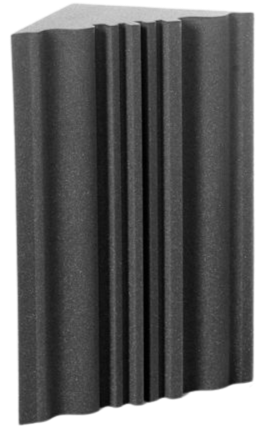
The key difference is in the bass. A professional 50mm panel absorbs 5 times more at 250 Hz than pyramid foam of the same thickness. And bass is where most real mixing problems live.
The low price myth
The flagship argument for Amazon foam is price: "12 panels for €20". Let's do the real maths.
Scenario: treating a 12m² room
Option A — 50mm pyramid foam (Amazon):
- 24 panels needed to cover key surfaces
- Total cost: €60-80
- Real absorption achieved: ~5.4 Sabine m² (24 × 0.5 m² × 0.45 NRC)
- Cost per m² absorbed: ~€13
- Result: RT60 drops by 25-30%, bass remains uncontrolled
Option B — Professional 50mm panel (28-40 kg/m³ density):
- 12 well-positioned panels
- Total cost: €350-400
- Real absorption achieved: ~10.2 Sabine m² (12 × 1 m² × 0.85 NRC)
- Cost per m² absorbed: ~€37
- Result: RT60 drops by 60-75%, control across mids and lower mids
At first glance the foam looks 3 times cheaper. But the cost per unit of real absorption is only 2.8 times lower. And the result is qualitatively different: with foam you still have a room you can't mix in with confidence.
It's like buying two cars because they're cheap when what you need is one that starts.
The 3 problems cheap foam does NOT solve
1. Room modes (30-200 Hz)
Standing waves between parallel walls create peaks of up to 20 dB at very specific frequencies. 25mm pyramid foam has an absorption coefficient of 0.05 at 125 Hz — meaning it reflects 95% of the energy. It does absolutely nothing about those peaks.
To treat room modes you need thicknesses of 100-200mm or tuned membrane resonators.
2. RT60 below 500 Hz
A domestic room's reverb time is unbalanced: in highs it might be 0.5s but in bass 1.5s. Thin foam only affects the highs, making the imbalance worse. You end up with a room that sounds "muffled" but with bass just as uncontrolled.
3. Early reflections with lower-mid energy
First reflection points need uniform absorption between 200 Hz and 8 kHz. 25mm foam only covers from 1 kHz upward, leaving the reflection coloured in the lower-mid range — exactly where vocals, guitars, and the bodies of kick and snare live.
When pyramid foam DOES make sense
It's not all inflated marketing. There are cases where cheap pyramid foam is a reasonable solution:
- Small voiceover booths (1-3 m²) where you only need to control short echo on voice
- Podcast rooms where no music is mixed and bass doesn't matter
- Temporary treatment while you save up for something serious
- As an additional layer over professional absorbers to modify high-frequency diffusion
If your use fits these cases, use it without guilt. The mistake is expecting it to solve problems it technically cannot solve.
The safety factor: Euroclass certification
This is the point almost no one mentions and the one that should worry you most.
Untreated polyurethane foam is highly flammable and releases hydrogen cyanide when burning. European regulation EN 13501-1 classifies construction materials by their fire reaction using the Euroclass scale:
- A1 / A2: non-combustible (mineral wool)
- B-s1,d0: combustible but hardly flammable, low smoke production, no flaming droplets (recommended minimum for habitable spaces)
- C, D, E: progressively more flammable
- F: unclassified (most generic Amazon foam)
The precedent is real: the Station Nightclub fire (Rhode Island, 2003) killed 100 people in under 6 minutes. The main accelerant was untreated polyurethane foam used as improvised acoustic insulation behind the stage.
A professional panel certified B-s1,d0 or a mineral wool panel (class A2) costs more, but it's the difference between a building material and decorative fuel.
Honest verdict
Buy Amazon pyramid foam if:
- Your use is pure voice (podcast, voiceover, streaming)
- The room is small (under 6m²)
- You accept replacing it every 3-4 years
- The space complies with evacuation regulations and there's no fire spread risk
Buy professional panels if:
- You mix or produce music
- You care about bass control
- The room is used several hours a day
- You want an investment that lasts 15+ years
- You're going to treat more than 8m² of surface
The practical rule: cost per m² of certified absorption is what matters, not cost per panel. And at equal real absorption, the gap between cheap foam and professional panel is much smaller than it looks.
How to know what your room actually needs
Before buying anything, you need to know how much absorption your room needs and in which frequency bands. This is calculated using Sabine's formula and the axial modes from the actual room dimensions.
Our acoustic configurator does that calculation for free: enter the dimensions, position your monitors, and it tells you exactly which type of panel you need, how many and where to place them. In 2 minutes you'll know whether your case justifies investing in professional product or whether cheap foam covers your real needs.
Better to spend just enough wisely than too much badly.