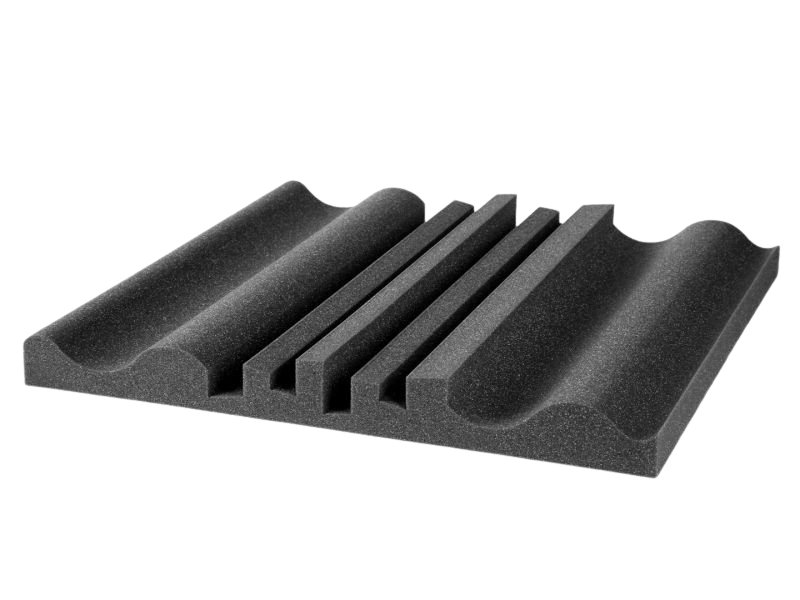
Professional high-density acoustic foam
The acoustic foam that Amazon pyramid foam isn't
Frecuentia acoustic foam (ZH FR28, 28 kg/m³) is engineered to actually absorb sound, not to decorate walls. Compared to cheap pyramid foam, it offers three times the density, E-d0 fire certification, and real absorption below 500 Hz. Supplied as 600×600×64 mm Havsvåg FR-950 panels.
- Real 28 kg/m³ density (vs. 10-15 kg/m³ for decorative foam)
- E-d0 fire certified — suitable for public venues
- NRC 0.75 measured in ASTM C423 reverberant chamber
- Absorbs from 250 Hz — pyramid foam only works above 500 Hz
- Open-cell polyurethane — durable, no irritant fibres
- Made in Spain · 48-72h shipping
What acoustic foam is
Acoustic foam is an open-cell porous material designed to dissipate sound energy through internal friction. As the wave enters the pores, air molecules vibrate against the cell walls and the energy turns into heat. It's the most widely used absorber in home studios for its performance-to-price ratio and ease of installation.
Not every foam works. The difference between professional acoustic foam and the "pyramid foam" sold at €1/panel comes down to density and effective thickness. Without those two parameters, what you're selling is an absorber that only works at high frequencies, leaving the room just as muddy in the mids and bass.
High-density foam vs Amazon pyramid foam
Direct comparison between marketplace decorative foam and Frecuentia ZH FR28:
- Density: 10-15 kg/m³ (Amazon) vs 28 kg/m³ (Frecuentia)
- Effective thickness: 30-40 mm vs 64 mm
- Absorption @ 250 Hz: ~0.05 vs 0.37
- Absorption @ 500 Hz: ~0.30 vs 0.72
- Fire certification: none vs E-d0 self-extinguishing
- Service life: 1-2 years vs 10+ years
In practice, 8 FR-950 panels do the work of 25-30 cheap foam panels, taking less wall space and with no fire risk.
How much acoustic foam do I need
Quantity depends on room size and shape. Reference:
- Voice booth / podcast (4-6 m²): 4-6 panels covering side walls and ceiling
- Small home studio (6-10 m²): 8 panels + 2-4 corner bass traps
- Medium home studio (10-15 m²): 12 panels + 4 bass traps
- Pro control room (15-25 m²): 16 panels + 6 bass traps + diffusers
For an exact calculation based on real room dimensions, materials and use, use our free acoustic configurator.
How to install acoustic foam
Three options, from least to most permanent:
- Double-sided tape (best for rentals): acoustic mounting tape at 4 points per panel. Removable without wall damage.
- Spray adhesive (3M Hi-Strength 90): durable bonding on smooth surfaces.
- Wood frame (DIY): pine battens screwed to the wall with panels framed in. A 25-50 mm air gap between panel and wall improves bass absorption.
Is it the same as soundproofing?
No. Acoustic foam treats how the room sounds inside — it reduces reverberation and comb-filtering. To stop sound entering or leaving (soundproofing) you need heavy mass (drywall layers, MLV, double walls) and mechanical decoupling. If you live in a flat, foam won't stop the neighbour's complaint.